
Special Subjects
The Early Childhood Education program at Grace is highly integrated, with concepts of reading, writing, math, science, social studies, and the arts seamlessly melded together. Our youngest students in Preschool and Prekindergarten leave their homerooms for the playground, the library, and music class, while other special subject teachers bring resources to them. By Kindergarten and Grade 1, students are traveling to special subject classrooms for instruction in art, music, science, Spanish, PE, and library. These journeys give them an expansive sense of school, of being part of the whole of Grace. Our art, science, and technology teachers also bring resources into the Preschool through Grade 1 classrooms, enriching hands-on learning projects with more stuff to take to the Makerspace, the sandbox, or the garden.
In the Elementary years of Grades 2-5, special subjects enrich and balance out strong core subjects. Students build relationships with the science teacher, the art teacher, the music teacher, the PE teacher, the Spanish teacher, and the learning specialist. Special subjects are therefore about more than exposure to new ways of knowing, more than making cross-curricular connections. Special subjects are an opening to broaden student-teacher relationships beyond the homeroom. They give students opportunities to expand their experience of relating to adults and learn that there are a multitude of teaching styles and approaches, as well as lots of different ways of learning about oneself and the world.
Click on the tabs to learn about the wonderfully well-rounded range of experiences in science, music, art, physical education and health, technology, and Spanish.
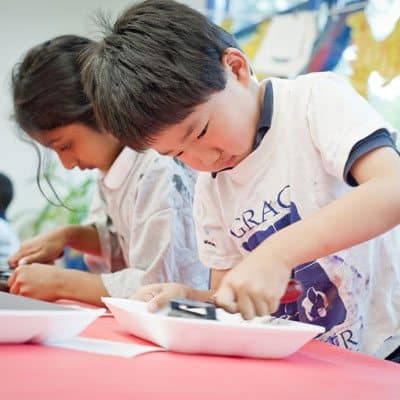
The Art program at Grace recognizes that each child is an artist. Through the methods and materials of art, students experiment, play, problem-solve, and exercise their creativity. By creating and observing art, students learn that art can be both a form of self-expression and a bridge to understanding others. The curriculum is grounded in critical and creative thinking and is inspired by students’ interests, project-based learning topics, and historical and contemporary art.
Grace students have the opportunity to create with a variety of media including ink, pastel, collage, paint, clay, papier mache, cardboard, wire, and found objects. Through work in all of these materials, students learn to envision, express, observe, reflect, engage and persist, stretch and explore, develop craft, and understand art communities. These eight Studio Habits of Mind serve students in the art studio and beyond. In addition to creating art, students practice understanding and connecting with works of art using Visual Thinking Strategies and Project Zero Thinking Routines.
The Art program honors the unique purposes and aesthetics of children’s art (not to be confused with adult purposes and aesthetics). Foundational to this approach are the “4P’s” of art - process, product, play, and permission (Axelsson, Orbach, & Pucci; 2022). At various moments and stages, both process and product will be important to children. A playful process allows students to discover the capabilities of materials and learn to problem-solve; authentic products fill children with a sense of pride and agency. Within this framework, it is the teacher’s responsibility to grant permission - permission to experiment, to make mistakes, to share, and to create.
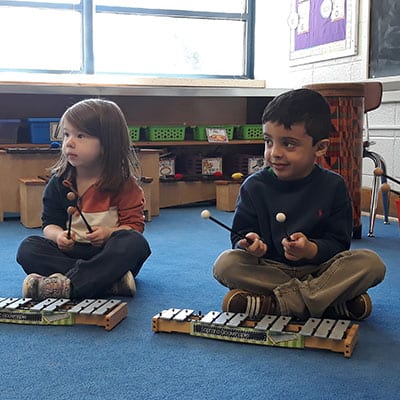
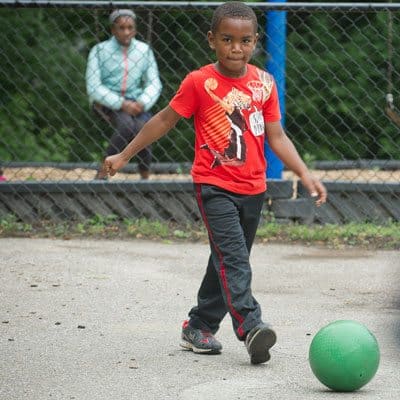 Students at Grace participate in a well-developed physical education curriculum that encourages fitness and a lifelong love of physical activity. The physical education program for our youngest students provides movement experiences that encourage children to explore spatial relationships, develop physical skills and enjoy movement challenges. A variety of activities and equipment are used to increase agility, coordination, and strength.
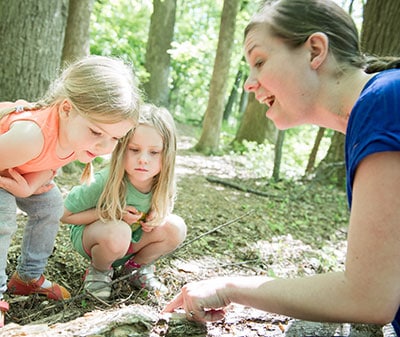 The science program for Early Childhood children encourages students to develop an awareness and appreciation of the natural world. Life, earth, and physical sciences are explored through hands-on experiences integrated throughout the curriculum. Children have opportunities to work with simple scientific tools and to observe, question, compare, classify, predict, experiment, and record. Indoor and outdoor learning experiences encourage excitement about phenomena such as: seasonal changes; caring for the environment; animal habitats and life cycles; the growth and health of our bodies; movement and gravity; and magnetism.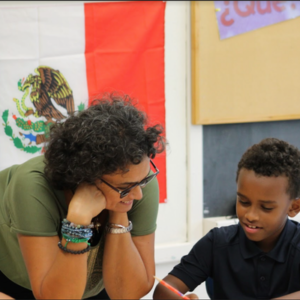
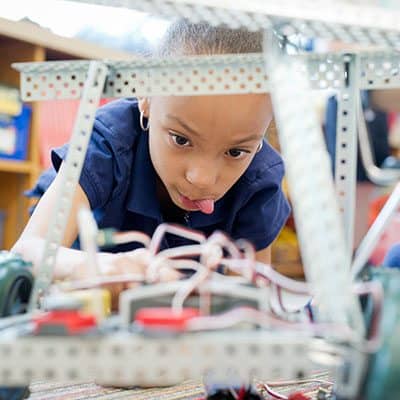 Technology and computers are viewed as teaching tools to be integrated into the learning experience. Grace believes that students should learn computer skills through the subjects that they are studying. The classroom teachers design activities that complement the development of computer skills with the content being taught in the classroom. The technology teachers are available to assist with planning lessons, helping students, and/or teaching specific computer skills.